Many Sergeant Majors, Few Stoplight Parrotfish, Single Squirrelfish… Are you a Squirrelfish Squirrelfish or Longspine Squirrelfish? These are the thoughts going through my head during my dive, marking down all the fish I can identify on my underwater survey paper. Afterwards, I’ll upload my data into REEF’s online database—one of the largest marine life databases worldwide.
This database has grown as a result of REEF’s flagship program, the Volunteer Fish Survey Project (VFSP). The VFSP is a citizen science effort, and runs off volunteers; any snorkeler or diver can contribute by recording the species and relative abundance of any fish they see underwater and uploading the data.

I first began to learn my Fish ID during orientation, while learning the Volunteer Fish Survey Project Presentation, which went over the most common fish you’re likely to encounter in the Florida Keys, their behavior, and different memory tricks to help remember them. These fish were pretty easy to remember, learning just a few fish from each family, especially as I studied and listened to the presentation many times in preparation for when I would teach it myself.
However, I was sure I had learned them when I went surveying for the first time with my fellow interns, led by REEF’s Education and Outreach Fellow, Maddie. After spending last summer in the Florida Keys as well, I was very familiar with the Keys’ coral reefs and the fish on them, however, I never knew the names of most of the fish. This time though, being able to identify all the different fish swimming around me, completely changed my experience. We were snorkeling, so Maddie was able to point out specific fish to us or we could ask questions on the surface.

Back at the office, we submitted our data together, and with two surveys under our belt, myself and the other interns were able to take our Level 2 Surveyor exam (REEF has different surveyor levels for data quality check reasons), which we all passed with flying colors. My journey as a surveyor had begun.
The rest of the summer I surveyed as much as possible. Although diving was not a part of our daily duties at REEF, we were given a half-day off each week where we could go diving for free with the local dive shops so that we could survey, which was an amazing perk. But one half-day wasn’t enough, and I’m glad my fellow interns were as excited about surveying as I was. They were always ready to go after work or on the weekends, whether it be off a friend’s boat or in the mangroves. We would spend hours talking about the fish we saw, and the ones we did and didn’t know.
Although I fell in love with the reefs of the Upper Keys and all the fish that lived there, one of my favorite surveying dives was at Blue Heron Bridge in Riviera Beach, Florida. Under the bridge, the water is less than 10 feet deep, but filled with tons of unique creatures, most I’d never seen before. Thankfully, there was a REEF staff member with us who was able to write out the fish we didn’t know on her survey slate, and the next day, we went through all the pictures we took to go over what we saw. With such a shallow site, we were able to dive for over 2 hours, and surveyed 60 different species!


By the end of the summer, I was an Expert Surveyor—and that’s not just a self-proclaimed title. After 25 surveys, I was qualified to take the Level 3 exam, along with two of the other interns. This one was a lot harder than the Level 2, with a lot more fish, but I felt prepared after a summer of surveying and learning more fish, and also biweekly Fish ID classes with Maddie where we would learn more fish from certain families like grunts and damselfish. With a little bit of studying, all three of us were able to pass.
However, I had reached 35 surveys, meaning I could even take the Level 4 exam. This one required a lot more studying. These exams apply to the entire Tropical Western Atlantic region, and a lot of the fish on the Level 4 exam weren’t common or seen at all in the Keys. The Level 4 exam also focused a lot more on fish families like Jacks, Blennies, and Gobies, where the differences between individual species are a lot smaller and harder to notice than with Angelfish, for example. I was able to pass though, getting over a 90% on the exam of 100 pictures where I had to identify the species and family.
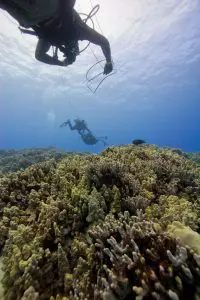
Surveying completely changed my dive experience, and made me feel so much more connected to the underwater world and the communities of fish that live there.
In the twelve weeks of my time with REEF, I submitted 37 surveys and recorded 130 different species on over 30 different sites.
Not only is it cool for me to be able to keep track of what fish I’ve seen or haven’t seen, but I’m now able to share something more tangible with others. Very few people get to experience ocean ecosystems like divers do, and surveying has helped, and will continue to help, me become a better advocate for the ocean and marine resources. I’m excited to continue surveying in the future, and to travel to more dive sites and grow my fish ID knowledge!