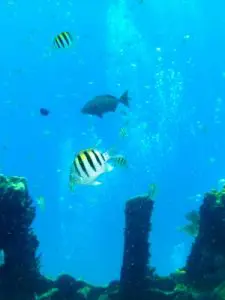
My arrival in Key Largo two weeks ago in many ways felt like a return to home. As a junior at the University of Kentucky, I studied abroad in Bonaire where I fell in love with the vibrant coral reefs ringing the small island. Since then I have been looking for ways to return to the tropics, and the Keys get pretty close. Lying just a few degrees above the Tropic of Cancer, Key Largo is by definition subtropical but has many of the same fish and invertebrates I spent countless hours studying in Bonaire. Here with my fellow interns and the staff at Reef Environmental Education Foundation (REEF) as the Dr. Jamie L King Marine Conservation Intern, I have had the chance to view this underwater world through the earnest lens of a nonprofit.

My time so far this summer has largely been split between three main avenues: working in and around REEF Headquarters; contributing to the Volunteer Fish Survey Project; and developing career skills such as my Divemaster certification. In the short time since my arrival, I have done everything from helping set up an aquarium tank for showcasing invasive lionfish, to diving with a group of spotted eagle rays on the local barrier reef, to swimming with manatees. While I have not gone diving every day, the office work that fills in the time between has been truly rewarding. Being an intern means being the face of REEF, in that many of REEF’s Volunteer Fish Surveyors never interact with any staff members in person. The organization has its roots in Key Largo, yet is truly global. While my interest as late has been in the Tropical Western Atlantic (TWA) region, there are databases for several other major regions throughout the world that volunteers collect and submit valuable fish sighting and abundance data. I am happy to have started a project creating TWA fish identification practice quizzes to help prepare intrepid surveyors for identifying fish on dives, and I plan to work on other regions such as the Pacific Northwest.

Just as exciting as REEF’s global reach, however, are the times that we are able to interact with the local community. While I have not had much involvement with education catered to a younger crowd in the past, being able to present on the ecology of the Florida Keys to middle school students recently made my day. I certainly see science as my career path, but I am also committed to making science accessible. REEF has offered me a great opportunity to develop this skill, and I look forward to outreach/education events in the future. Lionfish derbies are a great example, so stay tuned!

A large part of what has enabled me to reach this point as an Our World Underwater Intern has been gaining SCUBA certifications. Acquiring my Rescue and AAUS Scientific certifications while in Bonaire was instrumental in pushing my career forward in marine research, and the next step for me is achieving my Divemaster. One of the best things about REEF so far has been its absolute commitment to furthering its interns’ careers through both networking opportunities and providing access to diving. Both initiatives have helped me work with a dive shop in Islamorada called Key Dives, which will be training me to be a Divemaster throughout the summer. I am so privileged to be in this position, and I look forward to honing my dive skills in order to be a better scientist and instructor in the future.