The second half of my internship here at DAN has been packed to the brim with events. I have been able to complete my pilot study on the hydration status of scuba divers. In this observational study, I collected urine samples from divers pre- and post-dive and compared them to control samples with no dive in between. I then analyzed these samples for urine-specific gravity and osmolality in order to see how hydrated divers are entering and exiting a dive. I compared these changes to any changes that would normally occur during the day. I obtained great data from divers here at DAN, but the majority of the data came from our trip to West Palm Beach, Florida, for Lobster Mini Season. Here, we joined charters to take measurements on divers including urine samples, neurocognitive performance, subjective fatigue, skin conductivity, electrocardiograms, and more.

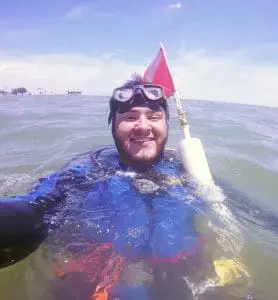
Here is a picture of me on the Pura Vida charter analyzing pre-dive urine samples while the divers are in the water.
We not only took measurements during this trip, but we also got to dive! Our first day on the road consisted of stopping in Charleston, South Carolina, to dive the Cooper River, where we hunted for prehistoric shark teeth and fossils. Our next stop we didn’t dive at, but we got to take a behind-the-scenes tour of the Georgia Aquarium in Atlanta. We then stopped in Blue Grotto in North Florida to dive the crystal-clear cavern on our way down. Finally, we also dove on the beautiful reefs in West Palm, which are some of the best that the Atlantic side of Florida has to offer.

Shark teeth I found in the Cooper River.

Above the Voyager pool at the Georgia Aquarium that houses whale sharks, manta rays, and many more species of fish and aquatic life.

At the bottom of the 100-foot cavern of Blue Grotto.

Myself and two other interns descending on the reefs of West Palm Beach.
Another project that I have been involved with recently is serving as a research subject at the Duke Hyperbaric Medical Center. I am involved in a study that is looking to see if a ketogenic diet is protective against oxygen toxicity in divers. For this study, I will enter their hyperbaric chamber two times; one time on a ketogenic diet and one time on a normal diet. For each round, I will be breathing 100% oxygen at a depth of 35 feet of sea water while hooked up to an electroencephalogram, electrocardiogram, IV line, electrodermal activity sensors, and expired gas monitors while peddling on an underwater ergometer and playing a flight simulation game. I will do this task for two hours each round, or until I show symptoms of oxygen toxicity. Another study that I have already completed is looking to see how we can automate the detection of venous gas emboli in divers. For this study, a Doppler device was used to listen to my heart sounds and the information is being used to train a device to listen for bubbles in the vasculature.