After over a year of waiting, I was glad to finally be the 2021 Dr. Lee H. Somers AAUS Intern with the Our World Underwater Scholarship Society (OWUSS). I was originally supposed to participate last summer, but COVID got in the way. Before the pandemic, I graduated with a degree in Environmental Science and Oceanography and I thought I should earn my AAUS certification. I’ve been diving for a few years, but up till now, only had my Advanced Open Water certification.
The goal with AAUS is to complete a minimum of 12 dives geared toward scientific diver training, but as a bonus I got my rescue, nitrox, and diving first aid for professional divers certifications, as well. I spent hours on the e-learnings before I arrived at my internship’s host university in Florida. Once there at the Vester Marine Station of Florida Gulf Coast University in southwest Florida, I started by practicing rescue skills in their massive swimming pool. Before this, I had never actually dived in a pool — not a lot of wildlife, but I must say the vis is great.
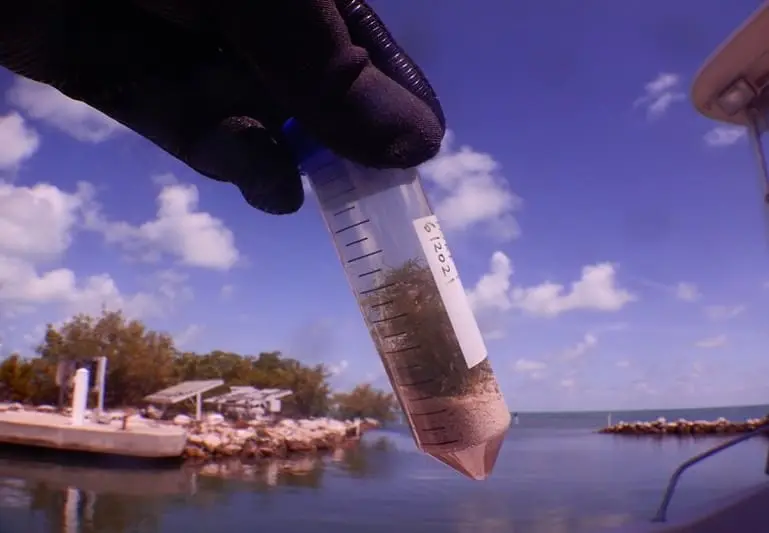
The following week, I got to join the DSO (Calli Johnson), Vester’s research coordinator (Adam Catasus), and research assistant/divemaster (Alex Donnenfeld) on a sampling trip to the Keys, where we were met with rough conditions. My buddy and I made sure to take lots of bonine after that. Our days there were spent collecting samples of halimeda and dictyota algae from various sites. After each dive, we would process the samples to gather the epiphytes growing on the algae to later be tested for ciguatera, a potent toxin that seafood-eaters would do best to avoid. We had to process the samples quickly on the rocking boat to preserve the cells. With only a small portion of sample water lost to the deck, we shook up the samples and poured them through sieves until we had enough epiphytes isolated to separate into test tubes.
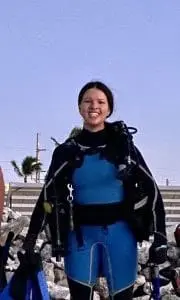
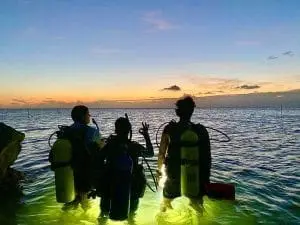
When we returned to the Keys Marine Lab where we were staying, we continued our rescue cert requirements by doing a standard CPR/First-Aid course, which was convenient since it had been two years since my last renewal. But the day was not over yet. After a day on the boat, we got right back in the water for some night dives to deploy screens that would collect more epiphytes. That was easy enough, except that my flashlight hardly worked and I was so exhausted I put my wetsuit on inside out.
The next day, we did the exact same thing: algae collection, on-boat sample processing, and night dives to collect the screens. My buddy and I went by ourselves for the screen recovery, and with some spotty navigation, we finally arrived at the screens and successfully recovered them on our own. On the last day, we did, surprise, the same thing, but finished with performing our open water rescues from depth and officially completed the rescue diver certification.