A week has passed since my last day at REEF and I am home reflecting on all the fins I got to see during my three months in The Keys.
Turtle Fins:
 I was able to help trained NOAA volunteers by going out on turtle walks. During the months of June and July, Loggerhead sea turtles come ashore in Islamorada to nest. On our Sea Oats Beach, we had 21 nests and 15 false crawls this season. A false crawl is a marked incident where it looks like a turtle has come ashore to nest but there was no nest dug; this usually happens if the turtle gets spooked or the conditions are unfavourable.
After 60 days since being marked, nests are checked regularly for signs of hatching. I was able to help excavate 3 nests this summer and released 3 baby turtles that were trapped in a nest. We collected data on the number of eggs and which of those were hatched/unhatched. Then we open the unhatched eggs to record if they are fertilized or not. All this information is important to monitor the turtle population in the area.
Fish Fins:
Since getting to know more fish species, I have started to appreciate seeing rare fish. For example, finding these Papillose blennies was a real thrill.


I spotted them during a dive with Allison and Carlos Estape who are established REEF members and fish ID experts. Carlos was very excited by my find as this was the first time they have seen this species in the keys or otherwise. It is an especially rare find because it is not listed in the Alligator Reef and Evirons paper which is the most comprehensive list of species of the area to date; it contains 618 different blenny species!
Another set of small fins belongs to the Mangrove blenny.

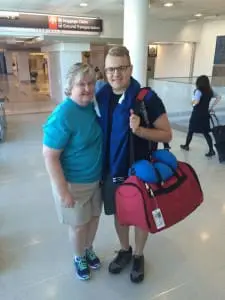
Amy Lee, REEF Trip Program and Communications Manager, informed us that she had seen a Mangrove blenny while snorkelling through some dock pilings. This was surprising news because Mangrove blennies have only been described to be in Cuba. So, we organized “The Great Bayside Blenny Hunt”. The group of us pictured below went out to find this far from home fish.

After a couple of hours snorkelling, we were able to capture two live specimen and obtain in situ pictures. The specimens were sent out to a lab for DNA sequencing and we received word that our predictions were correct: this was in fact a Mangrove blenny. Thanks to our efforts, it was the first time its DNA had been sequenced and the first specimen captured in Florida since the 1960s.
Human Fins:
A high percentage of my summer consisted of helping with educational programs. A specific one that I will always remember is Force Blue. Force Blue is a program that unites Special Operations veterans and marine conservation professionals to create a team of conservation warriors. Force Blue employs these veterans’ highly trained diving skills to assist in conservation efforts which accomplishes two missions: helping to assimilate combat veterans to civilian life and supply aid and bodies to citizen science initiatives.
 REEF participated in this program by training The Blue Force team to contribute to our database by surveying fish. We also educated them about the lionfish invasion and trained them to properly remove lionfish. It was an amazing opportunity to dive with these men and to learn a little bit about their world. For some of them, this was the first time they had seen a coral reef despite being trained divers for many years.
……
As far as the question I asked in my first blog, how REEF’s extensive database can be used to engage a wide audience on ocean conservation, I have decided to answer that by staying on past my internship to help with the Fishinar program. Fishinars are REEF’s brand of interactive webinars designed to teach the finer points of identifying fish. They are meant to be an aid for those already involved in our Volunteer Fish Survey Project and an introduction to fish surveying for those who are not. Fishinars can also be on relevant topics of ocean conservation.
I will be helping to grow this program by sourcing different advertisement opportunities and creating topics to deliver a Fishinar myself. Speaking, as a form of science communication, is a passion of mine and I am excited for the opportunity to grow that skill.
My time here at REEF gave me first hand experience in the world of marine conservation. Because of this experience, I now have a better understanding of where I want to contribute in the future. The connections I made and the chances I had to grow my skill set were invaluable. I have many people to thank but especially my supervisor, Ellie Splain for giving me the trust and encouragement to accomplish my goals this summer. As well, thank you to the Our World Underwater Scholarship Society who without, this experience would not have been the same.
Best Fishes,
Ronnie