Genece Grisby was born in California and grew up close to the Pacific Ocean. She devoured books about sharks and ichthyosaurs and loved watching Animal Planet (but only the ocean-related programs). With frequent trips to the beach, marsh, and nearby ponds, the aquatic world was always at her fingertips.
After Genece graduated from high school, the global pandemic disrupted her first two years of college. She stayed in her hometown, attending community college, and working remotely as a tutor and advising middle school students. While her love for marine science was always present, it took her some time before she decided to pursue a degree in this field. Originally majoring in general biology, she was unsure which direction to choose, as she was intrigued with both human and animal biology. It wasn’t until her last semester at community college, when she took an ecology course that introduced her to the wonders of marine biodiversity and population dynamics, that she decided to change her major upon transferring to the University of California, Davis.
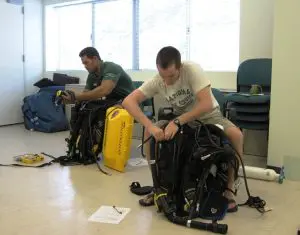
To make up for what felt like lost time, one of the first things Genece did after arriving in Davis was to become scuba-certified through the Davis Scuba Club. Her first open water experience was in Monterey, California, which is well known for its gorgeous kelp forests, challenging visibility, and cold temperatures. Despite the less than comfortable conditions, Genece remembers emerging from her first dive with her face hurting from smiling so much. She fell in love with diving, continued to dive in the rough waters of Monterey, and eventually became the President of the Davis Scuba Club. Genece is currently working toward her AAUS Scientific Diver and PADI Divemaster certifications.
In addition to becoming an avid diver, Genece held various marine science-related jobs at Davis. Her favorite position was serving as an undergraduate research assistant at UC Davis’s Bodega Marine Lab, where she focused on intertidal surveys, measuring kelp, collecting data on invertebrates, and developing coding skills. Overall, working at a lab so close to her childhood beach was a dream come true. In June, 2023, she will complete her B.S. in Marine and Coastal Science: Oceans and the Earth System and is excited for what the future holds.
Genece is enthusiastic about the myriad of opportunities the OWUSS scholarship may provide, such as enabling her to cultivate new experiences focused on marine science, explore and learn about marine protected areas, work with marine megafauna, and gain more experience in scientific diving. She also hopes to use the scholarship year to figure out her future research goals, learn new skills, and meet amazing people before pursuing a graduate degree.