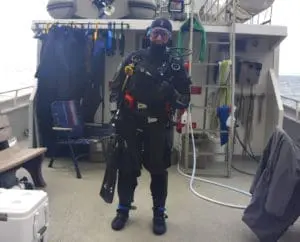

Early Thursday morning I packed my diving gear onto Gracie Lynn, the aquarium’s research vessel used for off coast specimen collection and scientific dives. We pushed off the dock a little after 6 a.m. and set out to go SMURFing. SMURF is an acronym for Standard Monitoring Unit for the Recruitment of Fish, and is a cost-effective tool used to determine spatial and temporal variability in abundance and diversity of settling fish larvae. The SMURFs consist of about 60 sq. ft. of snow fence, which is bundled up and encased in green garden fencing. The finished piece is sausage-shaped and about a meter long.

The color and design of this simple tool is appealing to juvenile fish who are seeking shelter. The fish are free to swim in and out of the SMURF, so it is important to quickly enclose the entire apparatus in a net, known as a BINCKE (Benthic Ichthyofauna Net for Coral/Kelp Environments), upon collection. The SMURFs are attached with clips to a mooring line a meter below the surface. The shallow working depth allowed us to use snorkel as our means of retrieving/ replacing the SMURFs.
 Kirsten Grorud-Colvert, the lead scientist on the project, and I were dropped off at each buoy while the boat circled around waiting for us to complete the task. With me carrying the BINCKE, and Kirsten carrying the replacement SMURF, we approached the buoy.
 I waited for Kirsten to unclip the SMURF from the mooring line and replace it with the new SMURF. As soon as she unclipped the old SMURF I scooped it into the BINCKE and we signaled for the boat to come back and pick us up.

There were a total of eight SMURFs deployed from the Southern Boundary of Pirate Cove to Rocky Creek Wayside (excluding Whale Cove), seven of which were still in tact at the time of collection. One was missing, most likely dislodged from strong currents or knocked off from driftwood, so we replaced it for the next round of collections. By the second SMURF collection Kirsten and I had the routine down and it only took a few minutes for us to collect and replace the SMURFs.
Once the retrieved SMURF was onboard, one person bailed seawater over the SMURF as another person shook it to flush out the fish. The fish were collected, and stored in individually labeled bags, which were kept on ice for transport back to the lab. The information gathered from SMURFs provides insight about settling patterns in early life stages for many nearshore fish species. This information is essential for effect marine conservation management, and will also act as a platform for educational outreach about the early life stages of marine organisms. As an efficient and low-cost method for sampling this type of information, it is hoped that SMURFs will become prevalent in large-scale monitoring projects throughout the west coast.